What is Quality Assurance (QA)? Process, Methods, and Examples in Software Development

In software development, quality assurance is one of the most critical parts of a successful software development process. If your development team fails to test any product, the whole process may be negatively affected. Have a clear understanding of aspects of quality assurance to make sure that you don't meet unexpected issues. In this blog, we would like to discuss QA, definition, process, methods, and examples in software development.
1. What is QA?
Quality Assurance, or QA in short, refers to a series of activities in improvement and maintenance to ensure the quality of software products or services. QA concentrates on improving the software development process and making it consistent and effective as per the particular quality standards defined for software products. Some of the popular quality assurance certifications to ensure are ISO 9000, CMMI model, TMM, ISO15504, etc.
The activities of the QA process are performed by the QA team (QA analyst, QA test automation, QA engineer) who have in-depth knowledge and relevant experience. They will work on the project together with other team members (product owner, project manager, business analyst, and developer) throughout the complete software development cycle. The aim is to build software products that meet the high required quality standards of organizations and customers.
The pros of QA:
- Save money.
- Increases client’s confidence.
- Prevent risks and unforeseen emergencies.
- Ensure a great user experience.
- Boost customer satisfaction.
- Promotes organization, productivity, and efficiency.
The cons of QA:
- Sometimes difficult to implement.
- Time-consuming.
- High cost.
2. The process of QA
In software development, the QA process consists of 6 phases. It’s shown in the picture below.
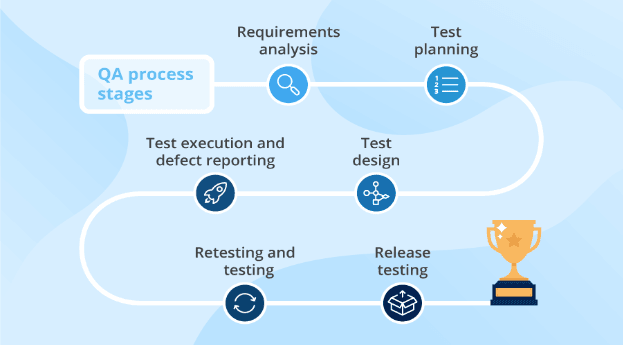 Image resource: https://www.scnsoft.com/software-testing/qa-process
2.1 Recruitments analysis
This phase is to review and analyze all of the functional and non-functional software requirements. Make sure that everything is clear, consistent, complete, traceable, and testable. This prevents possible software defects, avoids wasting resources, and makes next-test activities easier and more comfortable.
2.2 Test planning
After having a specific picture of requirements, you will build the complete plan of the QA process. The step-by-step guide requires your team to follow to deliver the best high-quality end product on time.
Test planning can include some factors. For example, the scope of testing, budget, timelines, deadlines, tools for testing, bug tracking and reporting procedures, human resources and their responsibilities, and others.
2.3 Test design
QA engineers will design test cases to check whether the products developed meet fully initial requirements or not. You can design based on the main QA activities including smoke testing, integration testing, performance testing (load testing, stress testing), security testing, cross-browser testing/cross-platform testing, and regression testing.
2.4 Test execution and defect reporting
The manual test engineers are responsible for executing the designed test cases, discovering defects, and recording them in a defect tracking system. At the same time, the automation test engineers use selected frameworks such as Selenium, Appium, and Protractor to execute automated test scripts and make reports. After that, the development team will resolve the existing defects that are reported by the QA team.
2.5 Retesting and regression testing
After the developers completely fix the issues, QA engineers will retest the required functionality and conduct regression testing. It ensures that bug fixes don't break the related functionality and hold it as initial as specified in the requirements.
2.6 Release testing
A release notification includes the list of implemented features, fixed defects, known issues, and limitations that will be issued by the development team. The test team performs smoke testing to make sure the build is stable. When successfully passed, execute the identified test suites, and issue a test result report when finished.
3. What are software quality factors?
To be recognized as a high-grade product, every software product must be evaluated by a wide range of requirements. Here are some important factors for evaluating the quality of software.
3.1 Performance
This is the capacity to perform transactions under a specified workload with an adequate response time.
3.2 Extensibility
This refers to the ability to add functions to the existing system without damaging it.
3.3 Usability
It ensures that the product offers a simple, clear, and friendly interface for end-users.
3.4 Security
Security is one of the top priorities of any development of the web and applications. Security defines the ability to protect personal data via authorization and authentication techniques.
4. The methods of QA
Based on software quality factors, there are a lot of quality assurance methods. Doing this is to guarantee products have no bugs. Software quality assurance methods can be divided into two main parts including non-functional and functional testing.
4.1 Non-functional testing
Four phases of non-functional testing are: Phase 1: Vulnerability Testing Find security holes and vulnerabilities in an app or site. Make sure that there are no security risks that could affect users’ information or other sensitive data.
Phase 2: Compatibility Testing This phase ensures that the product is completely compatible with the software and hardware it will be running on. Internet browsers, hardware, operating systems, and integral modules will be tested.
Phase 3: Usability Testing This testing evaluates characteristics related to intuitive and easy-to-use. Ensure that the end-users will use the product with a great UI design.
Phase 4: Performance Testing The objective of this test is to make sure the application runs as to initial expectations and requirements along with determining its limitations utilizing load testing.
4.2 Functional testing
Functional testing is also generally separated into four phases.
 Image resource: https://www.altexsoft.com/whitepapers/quality-assurance-quality-control-and-testing-the-basics-of-software-quality-management/
Phase 1: Component/ Unit Testing These units consist of individual software modules or parts that create a full system or application. Every module function is tested by a particular unit test installation written in a similar programming language to the module. The goal is to test each unit separately without looking at its role within the application as a whole.
Phase 2: Integration Testing Integration testing refers to testing multiple units together to see how efficiently they perform particular activities and tasks. Unlike unit testing, integration testing focuses on efficiency when all units work together to complete functions.
Phase 3: System Testing System testing increases the scale of integration testing to test the whole system. A standard system test involves running the whole system to discover previously unforeseen bugs, stability issues, and major problems.
Phase 4: Acceptance Testing Acceptance testing is the last phase of functional software testing, It includes testing the application based on its specifications and ensuring that the product meets all required prerequisites.
5. The software QA best practices
QA is critical to ensure the quality of any program, software, or application. Each development team needs to pay attention to the QA activities within the entire lifecycle of software development. Here are some of the best software quality assurance best practices when it comes to QA.
- Plan and record the testing process on quality assurance documentation.
- Test early and test often.
- Utilize automated testing.
- Apply effective methodologies.
- Prioritize bug fixes based on software usage.
- Keep in mind the user experience.
- Create a dedicated team for security and performance testing.
Conclusion
Nowadays, no one can deny the importance of quality assurance in software development. This is the reason why a lot of software quality assurance tools, methods, systems, and services are in information technology. Moreover, many companies offering quality assurance services have been established in recent times.
If your project doesn't have an efficient QA process, you need to have your own dedicated QA team or even work with other companies to support it. Reach out to Mobytelab to leverage the full benefits of quality assurance for your project.